

OpenAI o3 is the most advanced reasoning model from OpenAI, purpose-built for handling complex, high-cognition tasks. Launched in April 2025, it delivers exceptional performance in software engineering, mathematics, and scientific problem-solving. The model introduces three levels of reasoning effort—low, medium, and high—allowing users to balance between latency and depth of reasoning based on task complexity. o3 supports essential tools for developers, including function calling, structured outputs, and system-level messaging. With built-in vision capabilities, o3 can interpret and analyze images, making it suitable for multimodal applications. It’s available through Chat Completions API, Assistants API, and Batch API for flexible integration into enterprise and research workflows.
Web Site AI Model Web Page | |
Provider The entity that provides this model. | |
Chat Input a message to start chatting | |
Release Date When the model was first released. | 1 year ago Apr 16, 2025 |
Modalities Types of data this model can process | text images |
API Providers The providers that offer this model. (This is not an exhaustive list.) | OpenAI API |
Knowledge Cut-off Date When the model's knowledge was last updated. | - |
Open Source Whether the model's code is available for public use. | No |
Pricing Input Cost for processing tokens in your prompts | $10.00 per million tokens |
Pricing Output Cost for tokens generated by the model | $40.00 per million tokens |
MMLU Massive Multitask Language Understanding - Tests knowledge across 57 subjects including mathematics, history, law, and more | 82.9% Source |
MMLU-Pro A more robust MMLU benchmark with harder, reasoning-focused questions, a larger choice set, and reduced prompt sensitivity | - |
MMMU Massive Multitask Multimodal Understanding - Tests understanding across text, images, audio, and video | - |
HellaSwag A challenging sentence completion benchmark | - |
HumanEval Evaluates code generation and problem-solving capabilities | - |
MATH Tests mathematical problem-solving abilities across various difficulty levels | - |
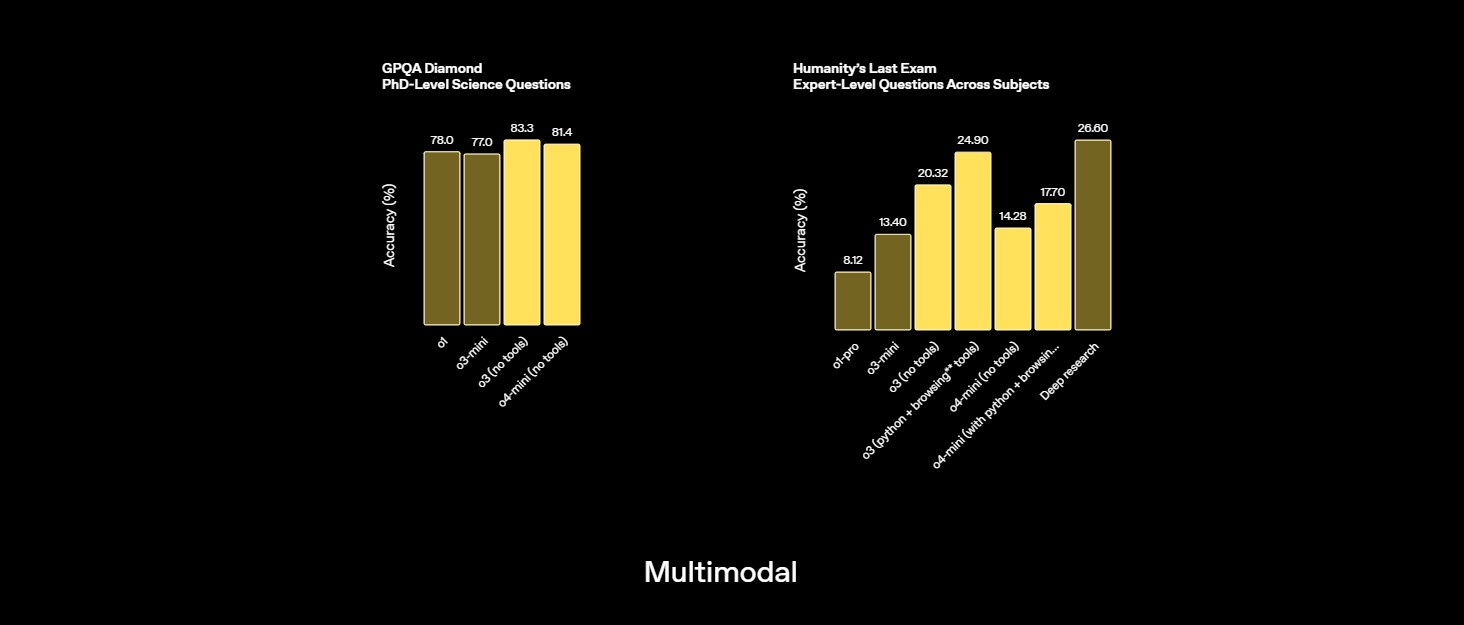
GPQA Tests PhD-level knowledge in chemistry, biology, and physics through multiple choice questions that require deep domain expertise | 83.3% Diamond, no tools Source |
IFEval Tests model's ability to accurately follow explicit formatting instructions, generate appropriate outputs, and maintain consistent instruction adherence across different tasks | - |
SimpleQA Assessing the accuracy of simple questions | - |
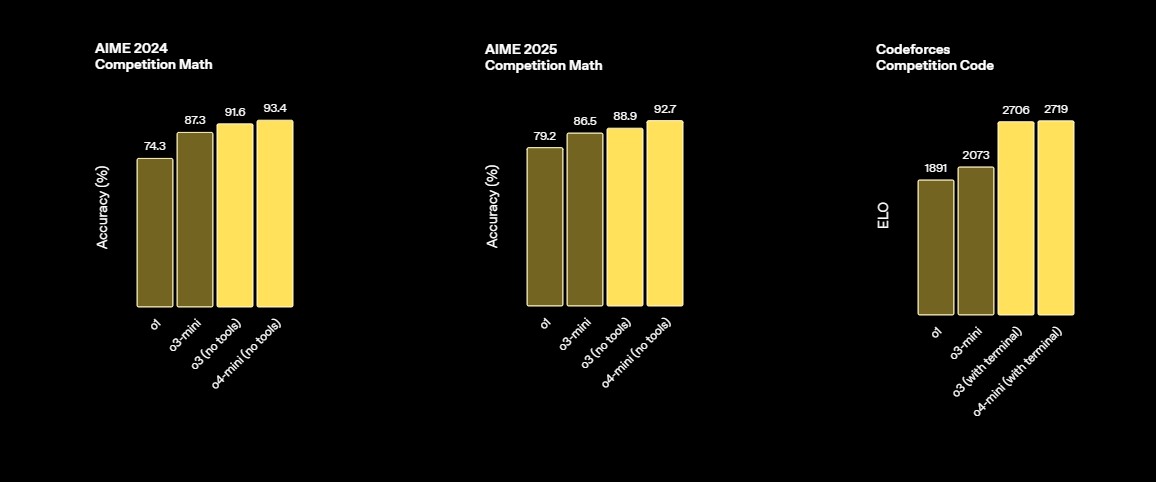
AIME 2024 | 91.6% Source |
AIME 2025 | 88.9% Source |
Aider Polyglot Multilingual programming benchmark. | - |
LiveCodeBench v5 Benchmark for real-time programming | - |
Global MMLU (Lite) A simplified version of the benchmark for assessing the universality of models at the global level. | - |
MathVista Evaluates the mathematical reasoning abilities of AI models within visual contexts | - |
Mobile Application | |
MathArena | |
| Avg. Score | 86% |
| AIME 2025 A test based on problems from the American Invitational Mathematics Examination, designed to assess the mathematical skills of models. | 89% |
| HMMT February 2025 A test based on problems from the Harvard-MIT Mathematics Tournament, February 2025, designed to assess the mathematical skills of models. | 78% |
| BRUMO 2025 | 96% |
| SMT 2025 A test based on problems from the Stanford Math Tournament, 2025, designed to assess the mathematical skills of models. | 88% |
| CMIMC 2025 A test based on problems from the Canadian Mathematical Olympiad, 2025, designed to assess the mathematical skills of models. | 78% |
Compare AI. Test. Benchmarks. Mobile Apps Chatbots, Sketch
Copyright © 2026 All Right Reserved.